
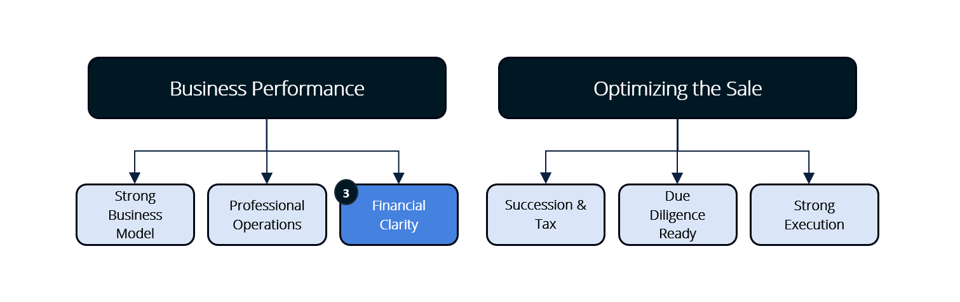
Part 3: Financial Visibility as the Foundation of Value – How Clarity Drives Premium Outcomes
Two companies with similar financial performance can achieve very different outcomes in a sale process. The distinction often lies not in growth, but in clarity. Buyers ultimately pay more for businesses where earnings are clear and supported by reliable reporting that withstands scrutiny during diligence.
In Part 2 of the From Operator to Optimizer series, the focus was on operational professionalization and how disciplined systems strengthen credibility and scalability. Financial visibility builds on that foundation. When reporting clearly explains where profits are generated and how performance is expected to evolve, buyers gain confidence in the numbers behind the story
Why Financial Visibility Matters to Buyers
Many mid-market companies treat financial reporting as a compliance exercise. Year-end statements are prepared, tax filings are completed, and management moves on. In a sale process, however, buyers are not simply reviewing historical results. They are assessing the credibility, durability, and trajectory of future earnings.
During diligence, buyers test whether reported performance reflects the underlying economics of the business. Common issues include:
Inconsistent cutoffs: Revenue or expenses recorded in different periods can distort trends and make performance difficult to evaluate.
Limited segmentation: Unsegmented, company-level reporting can mask which products, services, or customers actually drive profitability.
Missing KPIs: Without operational metrics, buyers struggle to connect financial results to the underlying drivers of performance.
When these gaps exist, buyers default to conservative assumptions. Each unanswered question slows diligence and weakens conviction in the numbers.
Conversely, when a company can clearly show where profits are generated, which customers or segments drive performance, and how results are expected to evolve, buyers gain confidence in the earnings profile.
What Financial Visibility Looks Like in Practice
Businesses with strong financial visibility share several common characteristics:
Consistent monthly reporting with reliable close processes.
Clear segmentation by product line, service offering, geography, or customer type.
Defined operational KPIs that connect financial performance to operational drivers.
Forward-looking forecasts supported by defensible assumptions.
Buyers are no longer left interpreting spreadsheets in isolation. Instead, they can see where revenue is generated, which segments drive profitability, and where growth opportunities exist.
Importantly, financial visibility signals disciplined management. It shows that leadership understands the operational drivers behind the numbers and actively manages performance rather than reacting to it.
For owners preparing for a transaction, these practices do more than organize reporting. They directly influence how buyers assess and price the business.
Financial Clarity as a Valuation Multiplier
Financial visibility improves valuation in two distinct ways during a transaction.
1. Reduced Perceived Risk
Clean reconciliations, segmented results, and month-over-month consistency help buyers verify that earnings are real and sustainable. For example, when revenue recognition reconciles across reporting periods, gross margins remain consistent, and fluctuations can be tied to operational drivers such as pricing, utilization, or input costs, buyers gain a clearer basis for evaluating performance. When reporting withstands diligence, the durability of earnings becomes easier to assess, often supporting stronger valuation multiples.
2. Stronger Strategic Positioning
When a business can clearly identify its highest-margin segments, most valuable customers, and operational constraints, buyers can underwrite growth with greater conviction. For example, segmented reporting may reveal that a particular service line consistently delivers higher margins or stronger customer retention. This clarity reinforces the strength of the business model and its drivers of performance and helps buyers model growth more precisely.
Ultimately, financial clarity is what converts strong operating performance into a valuation that reflects it.
What Actions Can a Private Company Owner Take Now?
Owners do not need a complete finance transformation to begin improving financial visibility. Focused improvements to reporting discipline and performance tracking can meaningfully strengthen both operational insight and buyer readiness. Many companies begin by addressing several foundational areas:
Implement segmented reporting: Breaking results down by service line, product category, geography, or customer group often reveals where profitability truly resides. Advisors frequently assist in identifying the segmentation that best reflects the economics of the business.
Track operational KPIs: Metrics such as utilization, billable hours, throughput, or downtime help connect financial outcomes to operational drivers. Establishing the right KPIs often requires aligning finance and operations around the same performance framework.
Develop forward-looking forecasts: Credible forecasts link operational assumptions to financial outcomes. Many management teams work with advisors to build forecasting models that clearly translate operational performance into expected financial results.
Standardize monthly reporting: Establish consistent close processes and reconciliation discipline so leadership teams can rely on timely, accurate performance data. External advisors can often help design reporting structures that support both management decision-making and buyer diligence.
Progress builds credibility. Buyers reward businesses that demonstrate intentional improvement and measurable control over their financial performance.
The Takeaway
Financial visibility is not about accounting. It is about confidence and clarity.
Companies that can articulate their financial story with clarity and precision reduce buyer skepticism, accelerate diligence, and strengthen negotiating leverage. In M&A, transparency isn’t just good practice. It is a differentiator. The benefits of that clarity extend beyond the transaction itself. Capital allocation becomes more targeted. Pricing strategies become clearer. Underperforming segments can be addressed earlier. Over time, management shifts from reactive problem-solving to proactive optimization.


Comments